
Show Notes
Episode 112. What Does Mental Health Actually Mean?
Episode 112. What Does Mental Health Actually Mean?
"The point of mental health, the whole thrust of it, is not just to be at peace alone in a vacuum. It's to be in connection with the people and the God that I'm related to."
~ Pat Millea
Why can't mental health professionals agree on what mental health is?
Why is the goal of mental health care not a life without discomfort?
If you're struggling, do you need more prayer, a therapist, or both?
In episode 112 of This Whole Life, Pat and Kenna Millea go back to the basics and answer the question underneath nearly every conversation they have: what do we actually mean by mental health? They start with why it is harder than it sounds. Ask 100 mental health professionals and you might get 100 answers, because defining mental health is really asking what it means to be human and what God intends for us.
Pat and Kenna then walk through the four-part definition they have developed at the Martin Center for Integration: mental health is using the mind and body, to accurately perceive reality, to respond to stressors and changes, in order to be in a loving relationship with God, self, and others. They bring each part down to earth, from how hunger and exhaustion change your mood, to checking a frustrating text message with someone you trust, to responding to a new season of family life with agency instead of reacting. And they explain why the goal of mental health care is not comfort, but a life that can be poured out in self-gift.
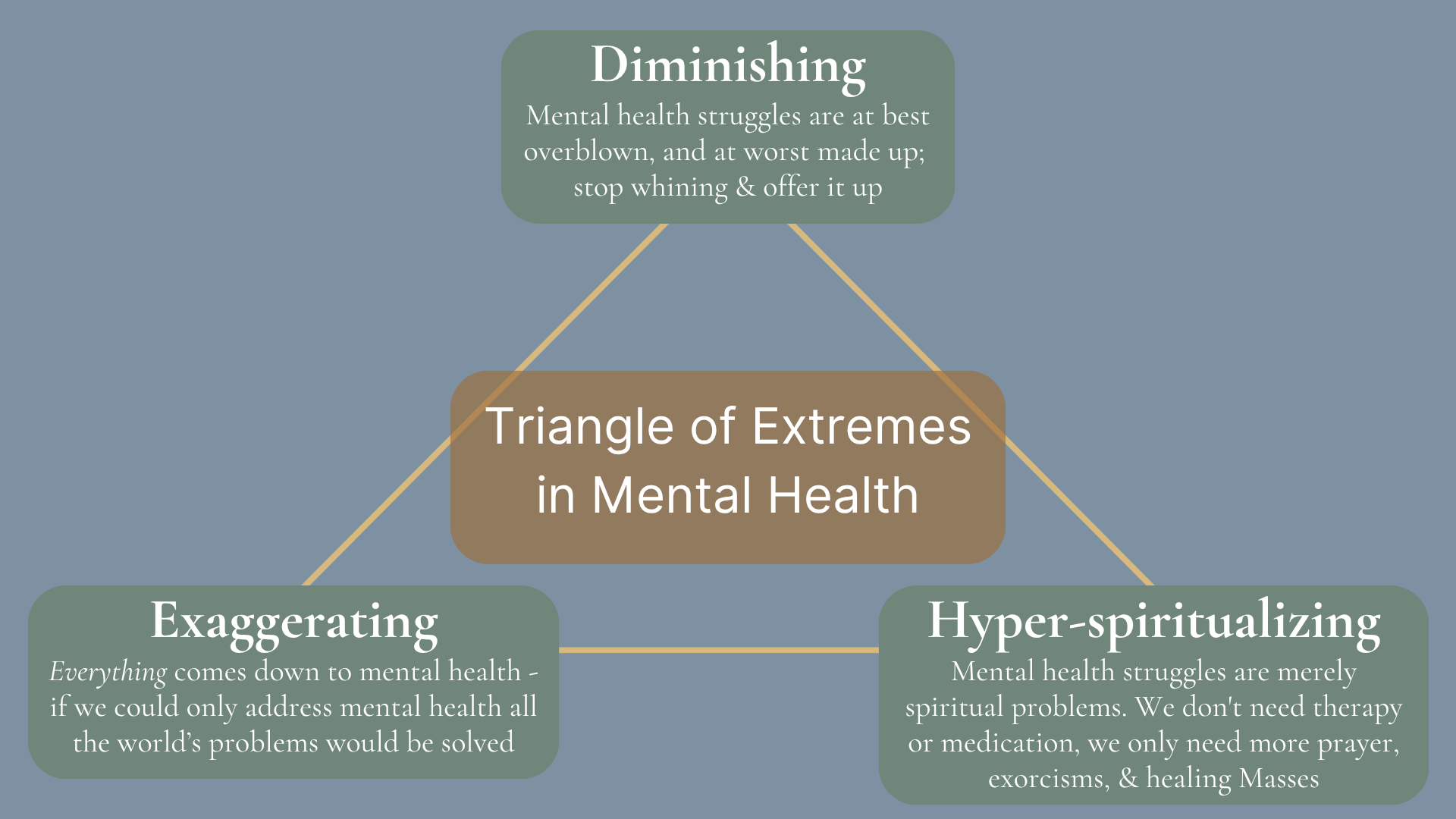
From there they name three extremes that take a seed of truth too far. Diminishing mental health says "toughen up" and skips the help people need. Exaggerating it treats mental health as the only real problem, and can turn its vocabulary into a trump card. Hyper-spiritualizing it says "you don't need a therapist, you need more hours in adoration." Pat explains why God ordinarily heals through other people, why healing does not always mean cured, and closes with a challenge by choice: where do you land on the triangle, and what is one step toward the middle?
This episode is for anyone who has wondered what mental health actually means, or whether faith and therapy are supposed to compete.
Show Notes
Our definition of Mental Health
Using the mind and body
to accurately perceive reality,
to respond to stressors & changes,
in order to be in loving relationship with God, self, & others
Our mental health is a great gift from God to be stewarded, much like our physical health
It’s important to know the Triangle of Extremes in Mental Health and where I find myself
“At the heart of liberty is the right to define one's own concept of existence, of meaning, of the universe, and of the mystery of human life.”
Planned Parenthood of SE PA v. Casey (1992)
Challenge By Choice
Where do you put yourself on the Triangle of Extremes?
When you’re faced with a mental health challenge or difficult relationship with mental health, are you more tempted to exaggerate, diminish, or hyper-spiritualize?
How open are you to taking a fresh look at your relationship with mental health? What would that look like?
Reflection Questions
For personal reflection or group discussion
What is one specific thing that stuck with you from this conversation?
What is your understanding of mental health? How would you define it?
Where do you see truth in our definition of mental health? What would you change or add?
Where do you see yourself on the Triangle of Extremes? Why do you view mental health that way?
If you were to move in one direction on the Triangle, what would one step be?